
VIGNETTES-Compilation 1
From The Chestnut Point Stories

VIGNETTES
Compilation 1
Jackson Tel
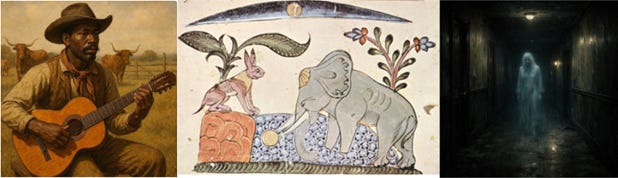
****
DIRECTORY
PAGE 3--1676-The Mother Tree
PAGE 15-1680-The Spanish Silver of Turtle Cay
PAGE 23-1883-A Guitar in One Hand
PAGE 25-1978-A Ghost in the Hallway
PAGE 29-1978-The Return of the Grimoire-260318-C
****
A Chestnut Point Stories Vignette
The Mother Tree
Before the Colonization of Maryland
Jim Eberton’s colonial-era writing desk, which occupied the sunlit bay of his third-floor bedroom in his Roland Park mansion, was a modest, hand-sawed and planed piece of furniture without drawers. It had been constructed of wood harvested from a legendary chestnut tree at the heart of the primordial grove dominating the high ground at Chestnut Point, overlooking the Patuxent River.
The Shawnee had reverently named the gigantic chestnut Neegah Mshkiki, or ‘Mother Tree’ in English, because it nourished all the creatures of the forest. Its immense canopy provided the perfect peaceful meeting place for people of all tribes to trade news, stories, and goods.
The ancient chestnut was sacred to the natives who lived at Chestnut Point, as well as to those on their annual migrations across the nearby Patuxent River to and from the Chesapeake Bay. They would ritually stop and pay homage to the Mother Tree, rest for a spell, replenish their supplies, and then continue onward to their destinations.
Unfortunately, the mammoth chestnut met its demise at the turn of the 18th century when a devastating derecho cut a wide swath through the towering primeval forest growing on the Point.
The lumber milled from the trunk and branches of the colossus filled an entire two-level stone bank barn. The hard, long-lasting wood provided the building material for many of the cabins in the surrounding area and was used for miles of rail fencing. The raw material was also transformed into thousands of personal-use items, including tools, furniture, and even carved doll heads.
One of those items, now belonging to Jim, was the writing desk manufactured two centuries before by an industrious flaxen-haired Swedish fur trader with steely blue eyes named Anders Joutsen.
It was in 1676 that Anders’ first wife, Emma, not suited for the rustic life at Fort Christiana in Delaware, left him for the comforts of Stockholm. The lonely woman, raising two children and running a small farm on her own, had become disgruntled by his long absences in the far reaches of the Appalachian frontier, where he had established a trading post.
After Emma left him, taking the children with her, Anders decided to make Chestnut Point his home permanently. He had become tired of the long treks to and from Fort Christiana anyway.
That prime spot had a magnificent view of the river valley below and beyond that, the forested piedmont rolling away in the distance towards the Chesapeake Bay. The incredible vista, ever-changing with the seasons and the weather, was especially spellbinding at sunrise in autumn, when the forest was ablaze with color.
Most importantly, it was from that vantage point, by looking through his telescope, that Anders could watch as native parties cautiously traversed the main crossing of the fast-flowing Patuxent River. Anders could then reliably estimate how long it would take them to ascend the deeply worn dirt path winding back and forth upward through the dense woods, to the top of the slope, and into the ancient chestnut grove growing on the Point.
There, at the center of that realm of forest giants, grew Neegah Mshkiki, the Mother Tree.
The sojourners would almost always stop to rest for a while under the venerated old chestnut, and they were among Anders’ most reliable trading customers. Whether headed northwest towards the mountain passes, or southeast towards the Bay, they would most likely want to stock up on supplies for the journey ahead, or maybe even trade for a gift to give someone special waiting at the trail’s end. And, of course, the always enterprising natives carried with them a selection of fine fur pelts and wampum to trade for what they needed or desired along the way.
Ander’s trading post was dug into the high slope, overlooking the Patuxent River to the east. It was earth-sheltered and fieldstone-lined on three sides. Across the exposed side, there was a log wall. The log-beam roof was insulated with sod that had become overgrown with tall grass and wild flowers. After his wife, Emma, and children returned to Sweden, Anders decided to renovate his trading post into a traditional log cabin for himself.
First, Anders pitch-coated the exposed exterior wall before completely burying it on the outside with seven tons of dirt and rubble. Thus, the now-completely-underground interior space was left intact for a conventional cellar. He intentionally retained the original north-wall stone fireplace, spring-fed water pump, copper basin, and drain board.
After structurally bracing the existing walls of the old trading post, fireplace, and chimney, he replaced the sod-covered roof with newly adzed floor joists. Along with laying down a thick oak plank floor, Anders framed up the columns, beams, and rafters for a one-and-a-half-story log cabin above. The strong, energetic Swede managed to finish all those labor-intensive tasks before the winter trapping season.
Then, throughout the following spring, summer, and fall, Anders worked diligently to finish the project.
In the middle of the new cabin’s first-floor front wall, now facing south downriver, he installed an ironwood-picket door with a chiseled flat piece of field granite serving as a porch stoop. Then on each side of the front entry, Anders framed out, then installed a pair of imported double-hung windows of Swedish manufacture, cautiously hauled from Fort Christiana to Chestnut Point by pack horse. They transformed the cabin’s dark interior into an ever-changing light show throughout the day.
Remarkably, the only damage sustained to either of the nine-over-nine pane windows during the journey was a slight crack in the lower right light of the bottom sash of the right side one, which Anders never bothered to repair.
The blown-glass windows were vulnerable points of entry, so Anders also installed blacksmith-welded solid-metal-plate shutters and a similarly wrought metal gate for the entrance way. Each was lockable from the inside. The protective gate had a peephole with a sliding cover, a small bolted hatch for exchanging items, and several strategically placed gun-barrel loops. Thankfully, those precautionary measures to ward off attack proved unnecessary during Anders’ lifetime.
However, the metal barriers once successfully prevented the violent breach of the cabin by an enormous, drunken black boar bear that had liberally availed itself of the thick, sweet honey and fruit liquor that Anders was brewing in the shack out back. The inebriated, fiercely vocal, wild creature was a mean drunk, not a jolly one.
Anders’ cozy new home featured a prominent open fireplace, a food-preparation counter with a spring-fed water pump, a drainboard and basin, a reasonably sized private bedroom for himself, and a sleeping loft for guests, all under the security of a weatherproof cedar-shake roof.
Anders could now live comfortably like his fellow colonists back home in Delaware. At first, he held out hope that his wife, Emma, would return to him with their two children, so he wanted the cabin to be a welcoming home. However, that was a happy ending never meant to be.
Initially, Anders used his new cellar to store wampum and other valuables needed to conduct business with the natives. To keep those items secure, Anders devised an ingenious way to reach the underground room from the first floor of the cabin above.
After the renovation, there were two covert ways to access Anders’ now-completely-underground private cellar. The original was an emergency escape route, involving shimmying through the stone-lined, gravity-fed water-supply tunnel that led down from the spring house higher up the slope. The newly invented access was a fiendishly clever puzzle that provided access through the first-floor girders of the cabin above—but only to those who could figure it out.
Not long after, the industrious settler took a second wife, a compactly built Shawnee healer who went by the shortened name of Neeshee. Unlike Emma, Neeshee was entirely at ease with life in the wilderness.
In those idyllic surroundings, the Swedish fur trader and the Shawnee healer, along with their growing family, contentedly thrived on Chestnut Point, overlooking the sparkling Patuxent River, flowing through the forested hills of the Maryland Piedmont, rolling into the distant slope towards the Chesapeake Bay.
During the passing decades, both easy and hard, Anders and Neeshee added several substantial extensions to their log cabin. Anders relegated his private cellar room mainly to storing root vegetables, pipe tobacco, and home-brew, but also to playing chess against himself on a white oak barrel that remained from his trading-post days. Anders’ intricately carved chess set of Asian ivory, worth a small fortune, was the one extravagance he had allowed himself to bring to the New World from Sweden. That was how the veteran fur trapper enjoyed spending his quiet time: playing chess against himself, consulting a seminal book on historic matches.
Only Anders had access to this secluded space, where he enjoyed uninterrupted respite from the frenetic hubbub of family life, because he alone knew the two secret techniques for gaining entrance.
Despite Ander’s best efforts to keep his personal refuge off-limits to others, the cellar became the clandestine meeting place for a certain two lovers: Mårten Joutsen, who was Ander’s botanist son by his first wife, and a tall, elegant, and brilliant French-Syrian immigrant to Maryland named Estella Chastaigne.
Mårten, like his pappa, was fair-skinned, blonde, blue-eyed, and consumed with love for both nature’s beauty and its utility. Estella, like her beloved grandfather in Aleppo, had dark eyes that could interpret the stars and delicate hands that could feel even the most subtle nuances of silk. Estella’s thick, long, ebony-colored hair reflected a lustrous auburn sheen when viewed in certain light. And her deep brown eyes sparkled with flecks of green. Those touches of color came courtesy of her wealthy French father, who was a prestigious broker of Syrian silks and Armenian gold.
The unlikely love affair between those two culturally dissimilar people began when the botanist, Mårten, traveled from Sweden to visit his father, Anders, while investigating the commercially valuable growths of ginseng, rumored to thrive along the banks of the upper Patuxent River.
After arriving in the Maryland Colony and traveling twenty-four miles by sail up the Patuxent River to the Port of Benedict Town, Mårten stayed for several days directly across the Post Road from the landing at an accommodation called Sheffield’s Tavern.
As it just so happened, that was when Estella was the tavern’s manager and the two of them hit it off in spectacular fashion. They clicked together, heart and mind, like strong magnets, becoming almost inseparable, so much so that Estella felt compelled to accompany Mårten upriver to the frontier destination called Chestnut Point.
About a month later, Anders, Neeshee, and other able-bodied family members went on a two-week journey to a Shawnee Bread Dance on the shores of the Youghiogheny River in the mountains of western Maryland. Taking advantage of that opportunity, Mårten and Estella, seeking privacy from the elderly folk and the children who had stayed behind, put their combined powers of logic and reasoning to good use, devising a trick to gain entrance to the underground room.
One would not be surprised to learn that when Anders returned home with the others, he quickly deduced the surreptitious canoodling that had occurred in the hidden cellar during his absence. Of course, he did—because a veteran trapper like him would miss practically none of the subtle happenings within his domain. However, it was his wife, the intuitive herbalist Neeshee, who first detected that Estella was with child and quietly shared that information with Anders.
Just before departing back downriver with Mårten, Estella, unaware that she was pregnant, said her extended goodbyes to Anders and Neeshee, as well as the other family members and friends at Chestnut Point.
That’s when the old frontiersman and his native wife each took Estella by a hand.
First, Neeshee said, “Please take care of our grandchild.”
Then Anders added, “We expect to be invited to the wedding.”
Estella, then 35, was utterly confounded by their words because she believed that she had been rendered barren by the prolonged, difficult, premature childbirth of her eleven-year-old son.
The unanticipated revelation concerning Estella being pregnant made matters very complicated for Mårten. He not only had important, pressing issues awaiting his attention back in Sweden, but he had conveniently not told his father that Estella was already married, though estranged, to a seafaring schooner captain named Robyn Mann. Nor had he shared the knowledge that Estella was also the devoted mother of an eleven-year-old boy named Jeremy, whom she had affectionately nicknamed ‘Early Bird,’ because he was born two full months premature and, as a result, was very small and slight in stature.
During her youth, while growing up downriver in Benedict Town, Estella and Mårten’s daughter, Annali, spent most of her summers away from the heat, humidity, and mosquitoes of the Maryland coastal plateau, in the cooler climes of the rolling piedmont upriver at Chestnut Point. There, little Annali spent many happy hours writing fanciful stories at the old chestnut-wood writing desk and then reading them aloud to her dolls, which she carefully lined up in rows on the surface, much like attentive schoolchildren.
Neeshee’s elderly father, Tekamthi, didn’t want to die until he had tasted chocolate, which he had heard was like heaven on earth.
The frail old warrior watched as his time on earth slipped past faster and faster each day. At that rate, Tekamthi formulated that his next-to-last day alive might well be merely a blink and the next a blink-by-half, and so on, until nature intervened to put an end to the infinite nonsense and let him move on to his next spirit life..
Then, suddenly one day, Tekamthi was startled yet thoroughly pleased when, unannounced, his lovely, nine-year-old great-granddaughter, Annali, newly arrived at Chestnut Point for the summer, entered the room with a big grin. The fair, blue-eyed, yet raven-haired girl was carefully balancing a serving tray on which rested an imported fine-china Swedish cup of cane-sugar-sweetened hot South American cocoa, sitting on an equally delicate matching saucer. Also upon the tray, Annali had placed a folded, soft cotton napkin, a small silver stirring spoon, and a matching china vase holding an artful arrangement of wildflowers freshly picked from the upper meadow.
And not only that, the cheerful girl had topped the creamy treat with a dollop of whipped cream and a sprinkle of ground nutmeg!
As Tekamthi very, very slowly and mindfully sipped the heavenly concoction, Annali sat by his side, watching with anticipation for his reaction.
The Shawnee elder wanted to savor the heavenly beverage forever. After licking the last drop of the deliciously sweet, thick liquid from his index finger, which he had used to wipe the inside of the china cup clean, Tekamthi lifted Annali’s soft hand to his lips in thanks. After which, he lay his head back down to doze, newly optimistic about what lay beyond.
Upon his passing, Anders bequeathed the chestnut-wood writing desk to his exotic-looking and remarkably gifted granddaughter, Annali. She had grown up to become a female author who published her popular tales under the pseudonym Jack Chapman because women of that era were not taken seriously as writers. Nevertheless, Anders was very proud of her success.
The old writing desk came into the possession of Sonny Mann, Jim Eberton’s father, and subsequently to him after three generations of Manns, starting with Estella’s son, Early Bird, baptized Jeremy Chastaigne Mann, who first inherited the Chestnut Point Estate.
In 1886, after the invention and commercial success of John Kemp Starley’s Rover safety bicycle, Jim’s mysterious father, Sonny Mann, moved from Chestnut Point into his military-style quarters near the Baltimore docks to establish a safety bicycle manufacturing factory of his own. He couldn’t have done it without the cooperation of his longtime partner in both adventure and business, Benny Barsky. They named the new entity the Superior Bicycle Manufacturing Company.
And with him, to Baltimore, from Chestnut Point, Sonny brought several select, utilitarian pieces of furniture. Among them was the colonial-era chestnut-wood writing desk, built almost two centuries earlier by a distant relative named Anders Joutsen.
Sonny, who, over the years, became comfortable living on the road, riding big-wheel bicycles from place to place with Barsky, had developed an extremely streamlined lifestyle and utilitarian tastes.
So, in a nutshell, that’s how and why the heirloom writing desk, constructed in the early 1700s by a Swedish fur trader with flaxen hair and steely blue eyes, was among the personal items that Sonny bequeathed, along with ownership of the Superior Bicycle Manufacturing Company, to a young stranger whom he figured out was his son born to a woman he once had fallen in love with named Letitia Eberton.
****
There’s Whizzies in the air.
****
A Chestnut Point Stories Vignette
The Spanish Silver of Turtle Cay
Jackson Tel
1680
So, by now, you are probably saying, “Silver-schmilver. No one in their right mind would be gullible enough to believe in a tall tale like the lost Spanish silver of Benedict Town.” If that is the case, you would be among the ranks of some very old and interesting company.
You see, back in the old, old days (we’re talking about two-and-a-half centuries before), none of Julius Teller’s drinking companions believed his tale about the Spanish silver either. The problem was that Julius could not resist stretching the truth past the point of believability. And it didn’t bolster Julius’s credibility that he always began with these words, in a low dramatic whisper, “Now, I am about to share a secret, but you have to swear to never, ever tell another soul.”
And most of those ‘trusted’ companions had already heard Julius’s story about the Spanish silver so many times that they could recite the beginning along with him, word for word, “Back in 1680, when I was but a nineteen-year-old lad, on a remote barrier island called Turtle Cay, I just so happened to be walking along a beach as the sun was going down when …”
But rather than retell Julius’s embellished version of his own story in its entirety, let’s take a stab at it by sticking to the facts as we know them. (Alright, here we go.)
The following is what happened to Julius Teller in 1680 when he was a nineteen-year-old novice seaman serving on a heavily armed square-rigger under the not-so-infamous buccaneer Sir Morley Pinchsnot. Notwithstanding his congested-proboscis-sounding surname, you probably have never heard of that person before. It is because maritime historians have not treated Captain Morley Pinchsnot’s memory kindly, to say the least, primarily due to the complete ineptitude he demonstrated on his first and only buccaneering venture at sea.
But for those interested in learning more about the man; according to the thin file available to researchers, Pinchsnot’s hastily commissioned and built ship the Gravitas was seized by a French privateer as a prize barely four months into its maiden voyage, and this is a direct quote from the record, “with not so much as a sneeze in resistance.”
Shortly after capturing the Gravitas, the French privateer captain came to the realization that the ill-made, leaky ship with a makeshift rudder was more trouble than it was worth. So he had it stripped of everything of value, forced Pinchsnot and his crew into two crowded longboats with one small keg of potable water between them, and lowered the whole lot down to the sea, ten leagues away from the coast of West Cornwall. He then ordered the Gravitas to be set ablaze. That evening, his logbook entry concluded with this phrase, “Bon débarras,” which translated to English meant “Good riddance.”
Years later, Julius would recount watching the ship burning on the horizon and thinking, I am better off in a rowboat.
But, even before that ignominious incident, right from the start of Pinchsnot’s ill-advised foray into the dangerous, highly speculative world of buccaneering, he displayed a remarkable disregard for prudent maritime procedure. First of all, the Gravitas, his newly commissioned and hastily constructed square-rigger, which imitated the basic design of an armed Spanish galleon, was, at Pinchsnot’s insistence, launched prematurely down the shipwright’s ramp in Bath, England. It seems that he was in a great hurry to catch up with a force of notorious buccaneers, gathering, at that time, in the Caribbean for an invasion of Porto Bello on the Isthmus of Panama.
Consequently, the want-to-be buccaneer captain set out from Bath poorly provisioned and with a hastily assembled crew in his impatience to join up with the so-called “Brethren of the Coast.” Pinchsnot commanded the Gravitas on a beeline across the Atlantic, through the treacherous Florida Straits, miraculously without incident, and then on a shortcut through Spanish waters in the Gulf of Mexico around the island of Cuba. For the duration of that desperate sprint, the crew of the Gravitas endured a leaking hull, a malfunctioning windlass, and other endless inconveniences due to the ship’s poor design and assembly.
Then, out of the blue, disaster struck. As they began rounding the western tip of Cuba while hugging the coastline to avoid the barrier reef, the Gravitas was overwhelmed by a gigantic towering wave, which first crashed furiously upon the narrow peninsula that jutted out from the island then continued onward in an angry turbulence of scrub trees, palms, drowned wild pigs, and corpses of cave-dwelling natives caught by surprise in the open. The wall of seawater then struck the ship at the stern, lifting and spinning it like a child’s toy, half-about-portside onto a submerged coral reef which destroyed the rudder, and swept three crew members away to their death.
(It was later noted by those fascinated by such things that the Gravitas encountered the colossal ocean swell approximately 2 hours after a series of violent tremors were reported on the island of Hispaniola about five hundred miles to the east-southeast. And they speculated that the two events were somehow related.)
Because they could no longer steer the badly leaking ship, the exhausted crew had to pump seawater from the hold for several weeks on end as it drifted, first westwardly towards the mainland and then northerly on currents up along the coast until it finally came to rest on the beach of an isolated barrier island within sight, on the horizon, of the mainland wilderness of New Spain.
Upon seeing that the sandy beach on that end of the island was teeming with egg-laying sea turtles, Captain Pinchsnot bestowed upon it the name ‘Turtle Cay’ and officially documented the island’s existence on his maritime chart. He then commanded the beleaguered crew to tow the ship by longboat and rope line around to a more discreet location on the inland side of the island so as to be hidden from any Spanish warship that might happen to sail past to the east. There they careened the boat on its side to fashion together, as best they could, a makeshift replacement rudder, make repairs to the damaged keel, and patch the leaks in the hull.
Now, according to Julius, while the ship carpenters were occupied with those renovations and repairs, he was assigned the task of scouring the expansive stretches of sandy beach and the windswept salt-grass dunes for dry branches and driftwood to make fires. And while engaged in that solitary activity,
Julius amused himself by collecting pretty shells and bits of surf-polished pink coral for jewelry he planned, sometime in the hopefully near future, to give as offerings to some real-life goddesses who, in the meantime, could only grace his imagination. (Being a young, strong, and incredibly -- or so he thought -- handsome lad and eager to sow some wild oats, a significant percentage of Julius’s mental activity was given over to the alluring charms of pretty young women. Most of the balance was consumed with schemes to make his fortune. He astutely postulated that if he succeeded in the latter, it would greatly assist in success with the former. And Julius dreamt that someday he would transform himself into a respected gentleman of wealth, with a beautiful, loving wife and a grand house full of happy children.
Those were the primary reasons Julius was so easily lured in by the vision of Spanish riches laid out before him by the recruiter for Sir Morley Pinchsnot’s buccaneering venture. (However, as the subsequent frustrating events of his long life proved, Julius was star-crossed on both accounts, making his fortune and landing a lovely wife. But, the sowing of wild oats was a different matter altogether.)
So, continuing with Julius’s Spanish silver story … Late in the afternoon of the very last day before shoving off from Turtle Cay, Julius was making his way along a stretch of ocean-side beach towards a small cove that had heretofore gone unnoticed by him. He speculated that the spot was likely the perfect catch basin for flotsam and possibly even jetsam and well worth the effort to trudge that distance through the deep sand. But he took his own sweet time to get there because it was one of those truly blessed evenings that make a person happy to be alive. And Julius certainly wasn’t in any hurry to return to the uncouth company of his Gravitas crewmates and then back in the morning to the close quarters and drudgery of life aboard the sailing ship.
A refreshing sprinkle of raindrops had just passed lazily across the island. The intense spotlight of the Gulf Coast Spring sun was scrimmed by a lingering bank of pregnant clouds, which softened the shadows and bestowed upon everything the vibrant painterly quality of a Renaissance artwork.
Then, as Julius slowly made his way around the shoreline of the cove, reveling in his meditative communion with nature, he suddenly came upon, to his complete and utter surprise, a piece of Spanish silver eight poking out of the sand. A few paces away from that spot, he found another.
And at that very same instant, according to Julius, an oculus-like hole opened in the low clouds drifting lethargically above him. And the sun beamed down through it in shafts of heavenly light at exactly the precise angle to illuminate a glittering field of silver coins spread across the shallow ocean bed of the calm, crystal-clear water just beyond the reef. It was the most magical and unforgettable moment of Julius’s entire life. (Too bad no one believed him whenever he told the story later.)
After those discoveries, Julius was shaking with excitement. He spent the remaining hour of daylight combing the shoreline but found only one more piece of silver eight. While carefully inspecting an area where a mound of small shells and tiny pebbles had collected against a large sun-and-seawater-bleached wooden beam (most likely from a ship of some kind), Julius kicked aside a clump of seaweed, and there it was, nestled inside like a shiny medallion.
By then, the sun, now an enormous glowing orange disk, was melting away into the ocean, and Julius could no longer see well enough to continue his search. Thankfully the clouds soon dissipated, and the full moon and the bright veil of stars overhead provided enough light for him to find his way back to the encampment on the other side of the island.
The next morning the Gravitas, now fully upright and back in the water, heaved off from Turtle Cay. But not to join the buccaneer attack on Porto Bello as initially planned but instead sail to British Barbados where the repairs to the ship could be completed more permanently. Unfortunately, upon reaching Barbados, they were turned away due to an outbreak of smallpox on the island. So the disheartened Captain Pinchsnot gave up on his grand venture and decided to limp back to England empty-handed to face the humiliating disappointment of his investors.
Then, adding insult to injury, after coming within ten leagues of the English coast, Sir Morley Pinchsnot and his ship, the Gravitas, were captured by a roving French Privateer. And later, as the barrister, representing the investors in the matter before the Maritime Board of Adjudication, derisively smirked for the record, “without so much as a sneeze in resistance.”
(You would be correct in assuming that during the journey back to England, Julius kept mum about his discovery of the Spanish silver and vowed to return to salvage it from the ocean shallows of Turtle Cay as soon as he could possibly manage it.
Oh yes, how Julius managed to conceal the three pieces of silver eight from his fellow Gravitas crew members and then from the French Privateers, and subsequently what happened with the Spanish coins afterward, is a story of intrigue we have saved for another day.)
But, and it was a big but, one thing in Julius’s tumultuous life led to another. The months turned into years. And, in what felt like the blink of an eye, Julius went from admiring the face in the mirror of a spry nineteen-year-old lad hoisting around a ditty bag packed with adventurous dreams to tolerating the weathered countenance of an achy sixty-one-year-old salt hauling around a duffle weighed down by unfulfilled expectations. And looking himself in the eye, he asked, “Julius Teller, where did the time go?”
However, Julius was not the type of person to ever give up on his dreams. If he said it once, he said it a hundred times, and always with his typical flair for the dramatic, “I solemnly swear, before they sew a sailcloth shroud, weighted by a cannonball, around my lifeless body, fasten me to a wooden board, and deliver me into the deep to feed the fishes, I will return to Turtle Cay and salvage that glittering field of Spanish eight. So help me, God.”
****
A Chestnut Point Stories Vignette
A Guitar in One Hand and a Gun in the Other
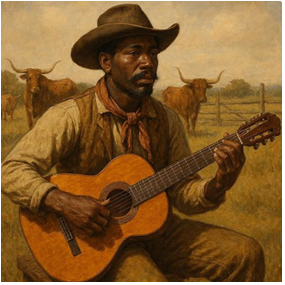
Alonzo Ochoa was born in the Indian Territory, now known as Oklahoma. The year was 1861.
His father and mother were both black Spaniards, and their family trees had grown together out of that very soil. They had been ranching cattle there for many, many generations.
That was, of course, before the Trail of Tears changed everything, before the evil white devils invaded that land to imprison the natives from whom they stole their land.
Yes, in those days, life was good for the Spanish cattle ranchers--not discounting the constant danger; after all, that land was the American wilderness.
One can only imagine the reasons why Alonzo grew up with a guitar in one hand, a gun in the other, a knife at his waist, and one in his boot. Yet, he always had a song in his heart.
From his friends, Alonzo always got a good ribbing about always getting distracted by Cherokee girls.
****
A Chestnut Point Stories Vignette
1978-The Ghost in the Hallway
In 1978, Charlie Mann froze to death under a snow bank on the shore of the Patuxent across from Haviland Mill.
Though transformative, the first 23 hours Travis Mann spent alone at Chestnut Point after Charlie’s funeral were nothing compared to the 24th one, right before sunrise. Having been a famous rock ‘ n ‘ roll guitarist and leader of the Travis Mann Band for several decades before, that was his customary bedtime.
The death of his grandfather, Charlie, had sent Travis into a spiral of depression. No exhaustion he had ever experienced could compare to the yawning pit of weariness he now felt while ascending the creaky stairs to his chosen bedroom tucked under the gable roof of the old main-house, the one with Jack Chapman’s journals in wooden crates lined up along the knee wall.
Then. ‘What was that!’
Travis thought he saw a movement in the inky dark hallway above, but he wasn’t sure. Travis stopped silent on the landing, his senses on edge. He gripped the finial of the newel post at the landing to call out. “Hello. Is someone there?”
Silence.
“Hello. Is someone there?” Travis was all eyes and ears. The hallway above was hidden in inky darkness. All sound was minuscule.
Silence…a rustle of fabric.
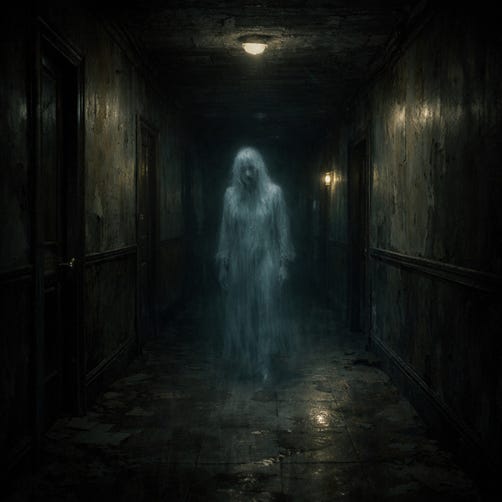
SUDDENLY, an ethereal wisp of a woman, dressed in a long satin silver house robe, appeared face-to-face with Travis. After both of them simultaneously screamed, she glared him in the eye. The jolt of surprise would have sent Travis tumbling backward down the stairs if he hadn’t instinctively grabbed hold of the finial atop the stair newel post to save himself.
“Who are you?” The woman hissed through a missing front tooth, which gave her a lispth. “Whaf are you doing in my house?”
At first, Travis believed he was having an LSD flashback. That would be more believable than actually seeing a ghost,’ he thought, reaching out to see if the woman was real.
“Answer me,” the woman demanded.
Travis blanked on his own name while having great difficulty suppressing laughter because she had said ‘Whaf,’ instead of ‘What.’
There’s a whole lot of story between there and then, so let’s take a break, for a sip, and a stretch.
But before leaving, let me say:
The Lady in the Hallway was the first ghost Travis encountered after permanently moving to Chestnut Point. He soon learned who she was and why she became a ghost. He also learned ‘how’, but ‘the why’ is always more important, don’t you think?
****
When the last one to remember you dies.
****
A Chestnut Point Stories Vignette
The Return of the Grimoire
1978, at Charlie Mann’s wake at Chestnut Point, Sunshine, Maryland
Travis Mann stood waiting at the front doors of the Manor House as if he were a stranger. Ringing the doorbell felt very weird because when he lived at Chestnut Point as a boy with his grandfather, Charlie, and Aunt Jennie, he had the run of the place, as did his sickly younger half-brother, Gerald.
“Come in, Dear.” Aunt Jennie said, delightedly ushering him inside the Manor House, “This is and always will be your home, Dear. You don’t have to knock, ”then, in the same breath, insisted, “Show me the book.
Chuckling at her impatience, Travis set his duffel down and said, “It’s in my bag. Then he asked, “Did my mother come?”
Aunt Jennie gently touched Travis’ cheek with withered fingers before answering, “No, dear, your mother didn’t respond to my invitation. I know how disappointed you must be. But your Pop-Pop is here. He has been waiting for you to arrive so he can say goodbye before moving on.
Travis was very familiar with the spooky way that Aunt Jennie spoke about certain dead people as if they were still around.
“Show me the book,” the witchy silver-phaired woman demanded.
“Can I take my coat off first? How about a welcome home hug?”
“Travis!” She still had total control over him, even now as an adult, using only her tone of voice,
Okay, okay, Aunt Jennie
After kneeling to unzip his leather duffel, Travis carefully removed the grimoire that he had found in an occult bookstore in Germany, which he had transported to Chestnut Point inside an old cigar box stuffed with crumpled butcher paper.
Travis handed the book unwrapped to Aunt Jennie. “Look at the inscription inside,” he said.
With trembling hands, Aunt Jennie opened the small children’s book of charms, incantations, and tales, written in Arabic.
After carefully examining the penned inscription, written on the inside cover leaf in French, ‘For my granddaughter, Estella Chastaigne Sevsaryan, 1704, she slowly turned the pages one by one. Finally, with a deep sigh, Aunt Jenny held the grimoire to her heart. She didn’t have to say it.
But Travis waited in anticipation anyway.
Aunt Jennie explained, “This book was Estella’s most precious childhood possession, and she mourned its loss until her death. It was given to her by her grandfather, Aghavni, the astronomer, when teaching her to read at his side. And thanks to you, my Darling, she finally got her wish.”
Travis reached out to take the grimoire back from Aunt Jennie, but she moved it out of reach, saying, “No, dear, it must be put in Estella’s library with her other books, where it belongs.”
With that, Aunt Jennie closed the grimoire and then commanded Travis, “Follow me,” before slowly turning to lead him down the central hallway into the ‘Log Cabin’ section of the Manor House, the oldest part onto which Estella had built a farmhouse after making Chestnut Point her permanent home in 1766.
Travis had never been allowed into Estella’s library when he was a boy living with his grandfather, Charlie, at Chestnut Point. So it was with great curiosity, mixed with residual childhood trepidation, that Travis, carrying his travel duffle and wearing his father’s leather World War II bomber jacket, followed his Aunt Jennie into the forbidden sanctuary.
****
Email: Jacksontelstories@gmail.com
Re: Vignettes Compilation 1